Bank Branding: Ideas, Inspiration & Best Practices
In a crowded and competitive market, banking institutions must find new ways to stand out, stay relevant, and connect with their customers. While many banks have embraced digital transformation and marketing innovation, building a powerful brand remains one of the most effective ways to drive growth and loyalty.
Unlike broader financial services firms, banks face a unique set of challenges and opportunities when it comes to branding. From legacy perceptions and regulatory constraints to shifting customer expectations and rising digital-first competitors, investing in a clear, consistent, and compelling brand identity is essential.
In 2026, that consistency has to extend further than ever. A bank’s brand now needs to hold up everywhere customers encounter it — from the branch and website to AI-generated search answers in tools like ChatGPT, Gemini, and Perplexity. A brand that reads differently across those touchpoints creates confusion where banks need confidence.
At Vested, we partner with our banking clients to build the best brands possible. In this article, we’ll explore the key components of successful bank branding, including focusing on your audience, visual identity, tone of voice, and customer experience. We’ll also share insights into how a financial branding agency can help bring your brand to life and keep it relevant for years to come.
- Bank Branding 101
- Bank Branding Tips & Best Practices
- How to Create a Bank Brand Kit
- Examples of Effective Bank Branding in 2026
- Frequently Asked Questions About Bank Branding
Bank Branding 101
What Is Bank Branding?
Bank branding is the process of creating a distinctive, trustworthy identity for a financial institution, encompassing personality, values, visual elements, and the experience customers have at every touchpoint. It is what separates a bank that customers choose from one they simply end up with.
In the digital era, a strong brand identity is no longer optional for banks. Consumers have more choices than ever, and those choices are increasingly driven by how an institution makes them feel. A well-built bank brand signals reliability, simplifies decision-making, and builds the kind of loyalty that advertising spend alone cannot buy.
Why Is Branding So Important for Banks?
Consumers are exposed to thousands of brand messages daily. That means running ads, however well-targeted, isn’t enough. The ads you run must stand out and be memorable, and that’s where your brand comes in.
Taking an honest look at your brand and improving it is a powerful way to set your bank apart. A bank’s brand can be the single most influential differentiator and an essential way to create new customer relationships. The balance is developing a brand that is distinct and unique, while still feeling like the trustworthy financial institution customers are looking for.
Bank Branding Tips & Best Practices
Bank branding is important, but it doesn’t need to be overwhelming. By implementing these best practices, you can build a strong bank brand with confidence.
Focus on Your Target Audience
Everything about your marketing strategy, including your bank brand, should revolve around your target audience. Make sure you understand their goals, what they are looking for in a bank, and what they like and dislike about your competitors (and you). Once you have a clear picture of your target audience, your brand can adapt to ensure you are reaching them effectively across all platforms.
Make Everything Easy
Your customers want convenience, but they still need to trust that your bank is reputable and confident in its services. Communicating to your target audience that working with your bank is easy will immediately start to win them over. Clarity in your messaging, simplicity in your product communication, and friction-free digital experiences all reinforce the same thing: this is a bank that respects your time.
Aim to Connect
People look to work with companies they can relate to and trust, and this is especially true for banks. Your goal should be to make a genuine connection with your target audience so they feel comfortable trusting you with their money, which is often the most important factor in customer decision-making.
The strongest bank brands go beyond rational benefits and build loyalty through feeling. Security, optimism, and belonging are emotional drivers that resonate far more deeply than product features or rate comparisons. A brand that makes customers feel understood is a brand they stay with.
Maintain Consistency Across Every Channel
Brand inconsistency is one of the most common and costly mistakes in bank marketing. Customers who encounter a warm, community-focused brand in a branch, then land on a cold, corporate website, or see a disconnected message on social media, experience a quiet erosion of trust.
Consistency means the same tone, visual identity, and core messages showing up across every touchpoint: branch, website, app, social media, and digital marketing campaigns. A consistent brand builds familiarity, and familiarity builds trust, the most valuable currency a bank can hold.
Establish Brand Governance and Ongoing Monitoring
Launching a brand is not the finish line. A strong bank brand requires assigned ownership of messaging, visual identity, and compliance language, plus a regular review cycle to ensure nothing has drifted. Marketing teams change, new channels emerge, and what was consistent two years ago may not be today.
Brand governance means having clear guidelines on who can produce brand content, what language is approved, and how brand updates get communicated internally. Ongoing monitoring means auditing regularly by reviewing how the bank is described across digital channels, checking that approved language is in use, and catching inconsistencies before they compound.
How Your Bank Brand Shows Up in AI Search
AI search engines are now summarizing and recommending banks before a customer ever reaches the bank’s own website. According to a 2026 EY Global AI Sentiment Survey of more than 18,000 consumers across 23 countries, 49% had used AI to support savings and investment decisions in the past six months. Banks that aren’t thinking about how they appear in those AI-generated answers are leaving a growing discovery channel unmanaged.
Those summaries are only as accurate as the structured, consistent content available about the brand. A bank whose website copy, press materials, and digital presence all describe the institution differently gives AI engines conflicting signals, and AI tends to surface the most repeated version, not necessarily the most accurate one.
Banks should periodically audit how they appear in tools like ChatGPT, Gemini, and Perplexity. Structuring content clearly with tight definitions, FAQ-style answers, and consistent boilerplate language improves the odds of being cited correctly. This is where brand governance and AI search optimization intersect, and where Vested’s AI search optimization practice helps regulated financial brands maintain control of their narrative.
Examples of Effective Bank Branding in 2026
The following case studies highlight how strategic branding can help banks define their identity, connect with target audiences, and stand out in a competitive market.
Battle Bank

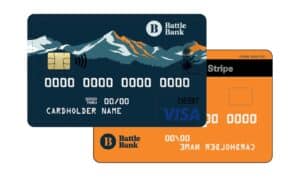
The Brand: Battle Bank is a bold new entrant in the banking sector, inspired by the rugged spirit of Battle Mountain. Its brand identity emphasizes simplicity, clarity, and a pioneering ethos, aiming to cut through the noise of traditional banking with a fresh, straightforward approach. The bank seeks to resonate with customers looking for transparent and innovative financial solutions.
The Approach: Vested collaborated closely with Battle Bank’s founders to build the brand from the ground up. This comprehensive process included developing a suite of logos, establishing brand guidelines, creating original imagery and iconography, and designing email templates and social media assets. A launch website was also constructed to provide information about upcoming products and services, introduce the founding team, and serve as a platform for prospective customers to join the bank’s waitlist. Vested also produced custom content for the bank’s waitlist and Founders Circle, and implemented a fully integrated PR and social media strategy to build Battle Bank’s profile.
Why It Works: Vested’s holistic branding strategy effectively translated Battle Bank’s vision into a cohesive and compelling brand identity. By focusing on simplicity and authenticity, the branding cuts through industry noise and resonates with target audiences. The integrated approach — combining visual design, content creation, digital presence, and strategic communications — ensures consistent messaging and engagement across all platforms, fostering trust and interest among potential customers.
Key Takeaway: A clear, simple identity built around a distinctive point of view cuts through category noise faster than feature-led messaging.
Masthaven
The Brand: Masthaven is a UK-based specialist challenger bank that distinguishes itself through personalized financial services — notably human underwriting and strong client relationships. Two years after its launch, Masthaven sought to refresh its brand to better connect with its dual external audiences, as well as internal stakeholders. Internal research had revealed a robust employer brand that needed to be more effectively communicated externally, emphasizing the strength and personalization of the Masthaven team.
The Approach: Vested collaborated with Masthaven on a comprehensive brand refresh. This involved in-depth analysis of mortgage brokers’ needs and the development of a new visual identity that balanced traditional finance with a youthful energy. Key elements included selecting new fonts, creating a warm color palette, and developing unique double-exposure photography to highlight customer aspirations. Vested also applied the new brand guidelines across digital and print collateral, including business stationery and product guides, and designed a new website optimized for both desktop and mobile devices.
Why It Works: Vested’s holistic branding strategy effectively translated Masthaven’s internal strengths into a cohesive and compelling external brand identity. By focusing on personalization and human connection, the rebrand resonated with both retail savers and mortgage brokers. The integrated approach ensured consistent messaging and engagement across all platforms, fostering trust and interest among potential customers.
Key Takeaway: Aligning an external brand refresh with internal employer-brand strengths creates authenticity that customers and partners can feel and competitors can’t replicate.
How to Create a Bank Brand Kit
There are many areas of a bank brand that must be addressed, which is why bank brand kits were created. A bank brand kit is a practical resource that organizes and creates cohesion across the business (essentially the rules of your brand) and ensures that brand consistency is applied across all channels.
Brand Strategy
Creating a successful brand strategy for banks is a nuanced process. It involves establishing a trustworthy and memorable image while setting yourself apart from competitors. There should be a focus on conveying reliability, security, and expertise, as well as crafting a compelling brand message that speaks to the needs and aspirations of your target audience. Consistency in visual identity, messaging, and customer interactions is vital to building trust.
Using digital marketing and social media can expand your reach and engagement. Ongoing monitoring and adaptation are equally important as bank brands must stay current with changing market dynamics and customer expectations. For a full framework, see Vested’s complete guide to brand strategy for financial services.
Brand Identity
Creating an identity for your bank brand is a major part of creating a brand strategy. Your bank’s brand identity will include your origin story, who you are, and what your business stands for. It should embody your company’s vision, goals, and core values, and showcase your brand’s personality in a way your target audience will remember and relate to. Think of it as the voice of your brand, or who it would be if it were a person.
Brand Kit Materials
Every brand kit includes features that make your brand identity your own. Each part plays a role in defining who you are. A modern brand kit should also define the brand’s written language (approved taglines, boilerplate descriptions, and key messaging) because that copy feeds your website, PR, and the AI-generated summaries that increasingly shape how customers first encounter you.
Logo
A logo is the visual representation of your company. Choosing a logo is as important as choosing your name. A brand’s logo grabs attention, should be memorable, and sets you apart from competitors. The brand kit should include not just the logo and approved variations, but specific rules guiding usage and alteration.
Colors
Establishing trademark colors is an important part of how customers recognize your company. A consistent color palette creates familiarity and trust, typically with one main color with secondary and sometimes tertiary accent colors. Explore the meaning of colors and what makes sense for your brand. These colors should be visually pleasing, work together, and connect meaningfully to your brand’s personality.
Typography
Brand typography includes the company’s font choices and the spacing of letters and words. Consistency in typography must be maintained across all channels. The font should first and foremost be clear and easy to read, and the right choice can convey sophistication and a more professional appearance. Most brands use one primary font and a few secondary fonts that complement each other.
Iconography
Iconography is the use of visual images, symbols, or figures to represent your bank and the ideas and themes behind it. Your brand iconography will be the image immediately associated with your institution.
Imagery
Brand imagery defines the aesthetic appearance of your brand’s core messaging. It is a visual storytelling component of your brand identity. Imagery means illustrations, icons and symbols, charts and graphs, video, and infographics. The images you choose will make an immediate impression, faster than any words your target audience will read. These choices matter.
Frequently Asked Questions About Bank Branding
What is bank branding?
Bank branding is the process of building a distinctive, trustworthy identity for a financial institution.. It covers visual design, messaging, tone of voice, and the experience customers have across every touchpoint. It goes beyond a logo or color palette to define how a bank is perceived, remembered, and recommended.
Why is bank branding important?
In a market where consumers are exposed to thousands of brand messages daily, standing out requires more than advertising spend. A strong bank brand builds recognition, earns trust, and drives loyalty, all of which reduce the cost of customer acquisition over time. It is often the most durable competitive advantage a bank can build.
How is bank branding different from general financial services branding?
Banks operate under specific regulatory constraints and carry legacy reputations that most other financial services firms don’t. They also serve broader consumer audiences, which means branding must navigate trust and accessibility simultaneously. The stakes for consistency and compliance in messaging are higher, and the challenge of differentiating within a conservative category requires more deliberate creative strategy. For a deeper look at financial services branding more broadly, see Vested’s financial services branding capabilities.
How often should a bank refresh its brand?
Most banks benefit from a substantive brand review every three to five years, with lighter ongoing audits in between. Triggers for a more significant refresh include a merger or acquisition, a major shift in target audience, a new product strategy, or (increasingly common) a mismatch between how the bank describes itself and how it appears in AI-generated search results.
Now It’s Your Turn
You’ve got the basics covered and understand the importance of a bank brand and what it can do for your business. It’s all about creating that trustworthy and memorable identity that your customers can connect to. Your goal will always be to reach your target audience where they are by understanding their goals, needs, and interests.
A bank brand kit brings together many different areas and helps you stay strong and consistent across all platforms. And in 2026, that consistency has to extend to every channel where customers find you, including digital campaigns, content marketing, and the AI-generated answers that now shape first impressions before a customer ever clicks through to your site.
If you are ready to revisit your brand and want it done at a high level, Vested’s branding and marketing team is here to make it happen. As a financial-services-only agency, we support banks across the full brand lifecycle from strategy and identity through launch and ongoing visibility.